The ₹4 Lakh Question: What Swiggy and Zomato Really Cost a Kerala Restaurant
A busy Kerala restaurant can hand aggregators over ₹4 lakh a month in commission. Here is the real maths, and the WhatsApp channel that keeps it.
A busy Kerala restaurant can hand aggregators over ₹4 lakh a month in commission. Here is the real maths, and the WhatsApp channel that keeps it.
Previous article
Oman, Saudi Arabia, and UAE are official Kerala international tourist source markets. Kozhikode has centuries of Arab trade history. Kochi is cosmopolitan. Yet almost no restaurants serve these guests an Arabic menu. Here is the opportunity.
Next article
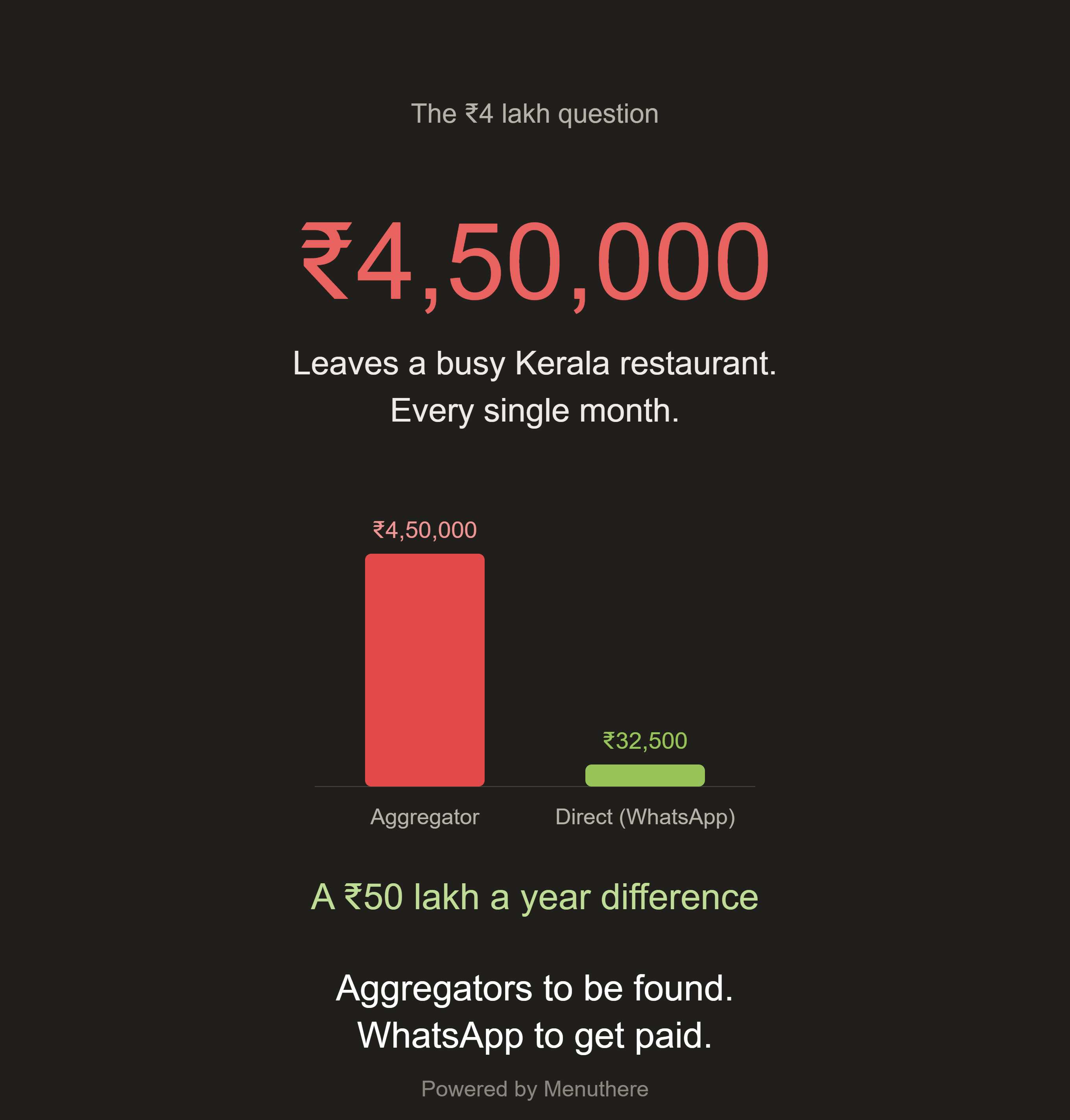
Run a simple sum for a busy family restaurant in Kerala. A hundred delivery orders a day, ₹500 on an average bill, and an effective aggregator take of about 30 percent once commission, payment fees and GST are added up. That is ₹4,50,000 leaving the business every single month, before a single rupee of rent, salary or gas is paid.
Most owners have never written that number down. They feel it at the end of the month, when the sales look healthy and the bank balance does not. This is the ₹4 lakh question: where did the money go, and was the channel that took it worth the price?
The base commission on Swiggy and Zomato in 2026 sits in the high teens to thirty percent range. Add the payment collection fee, the platform surcharge and GST, and operators report the effective cost landing closer to 25 to 35 percent of order value. On the example above, even a clean 30 percent is ₹4.5 lakh a month, or roughly ₹54 lakh a year.
Plug your own numbers into the calculator and the picture sharpens. Drop the orders, raise the average bill, change the commission to the rate your contract actually charges. The shape of the answer rarely changes. For any restaurant doing real delivery volume, the annual figure is a number with a lot of zeroes, and it is going to a channel that also owns the relationship with your customer.
The commission line is only the visible cost. Three more sit underneath it.
The first is discounting. Platforms expect restaurants to fund a large share of the “flat ₹125 off” promotions that drive the orders, and industry reporting puts that contribution anywhere from half to all of the discount. Stack mandatory discounts on top of commission and net margins on aggregator orders can fall below ten percent. You can be busier than ever and poorer for it.
The second is pay to be seen. Both platforms have moved to tiered commissions and paid priority placement, so visibility itself is now a separate spend. The restaurant that pays more shows up higher. The one that does not, quietly disappears down the list.
The third is the data blackout. The customer who orders your food through an app is the platform’s customer, not yours. You do not get their number, you cannot bring them back, and you cannot build anything you own. You rent the relationship by the order, forever.
Now run the other side. Take those same hundred orders a day and put them through a direct channel. The cost is a small monthly platform fee plus the payment charge, and in India that payment charge is where the surprise lives. With UPI carrying the overwhelming majority of restaurant payments already, the processing cost on a direct order can be close to nothing. Model it at a conservative two percent and a busy restaurant’s direct channel costs around ₹32,500 a month against ₹4.5 lakh on the aggregator.
That gap, more than ₹4 lakh a month and around ₹50 lakh a year, is not a rounding error. It is a second outlet. It is a loan cleared. It is the difference between a restaurant that survives the year and one that thrives in it.
Two cautions keep this honest. You will not move every order to direct, so treat the headline as the ceiling, not the plan. And aggregators still do one thing well, which is putting you in front of someone who has never heard of you. The goal is not to delete them. It is to stop paying a third of the bill to serve a regular their usual order every Friday.
Before changing anything, calculate your actual monthly aggregator cost. Pull last month’s settlement reports, add commission, fees, GST and the discounts you funded, and divide by nothing. That single figure is the most persuasive thing in your business. Most owners change strategy the moment they see it.
Let aggregators do what they are good at, which is acquisition. Treat every aggregator order as a paid advertisement that introduced a new face. The job from there is to move that face onto a channel you own before the second order, not to keep paying commission on the tenth.
The channel your customers already trust is sitting on their phone. A WhatsApp ordering setup lets a guest see your full menu and place an order inside a chat, with no app to download and no account to create. Menuthere turns your QR menu into exactly this, so the same code on the table or the bill takes the order on WhatsApp and the relationship stays yours, not the platform’s.
A direct order gives you the one thing an aggregator never will, the customer’s phone number, with their permission. Ask for opt in at the first order, then a captured number powers reorders, a “your usual” nudge, and a win back message months later. That list is an asset that compounds. The aggregator’s list never becomes yours.
Around nine in ten restaurant payments in India already run on UPI and other digital methods. A direct channel that settles over UPI keeps the payment cost near zero, which is the quiet reason the direct column in the calculator stays so small.
If you need delivery logistics without aggregator economics, the open network now operates in hundreds of cities at single digit commission with full access to your customer data. It is a serious third option between running your own riders and paying 30 percent.
South India is not a side market in food delivery, it carries the largest share of online orders in the country, and the overall food service market is on track to nearly double by the end of the decade. The demand is not the problem. The leak is.
The restaurants that win the next few years in Kerala will not be the ones with the most aggregator orders. They will be the ones who used aggregators to get found and a channel they own to get paid. The ₹4 lakh question has a simple answer once you have seen your own number. The only mistake is never running the sum.
Run your number, then keep it. Menuthere turns your QR menu into a full WhatsApp ordering channel, so your regulars reorder in the chat they already use and the commission stays in your account.
Calculate your savings →
Sources: industry commission breakdowns for Zomato and Swiggy 2026, Restaurant Coach (tiered commission and priority listing), Restroworks (India restaurant statistics, South India delivery share, digital payment adoption, market size), reporting on ONDC commission and coverage.
That "Flat ₹125 off" was not the platform's gift to your customer. You paid for it. Here is how the discount trap shrinks profit while volume grows.
WhatsApp ordering
Most operators know this number. It gets quoted in every WhatsApp group in the industry. What gets discussed far less is the second cost, the one that never appears on the invoice.
WhatsApp ordering
You built a structured ordering flow. The customer thinks they are talking to a restaurant. They are not wrong, because it is a chat. Here is how to design for that.