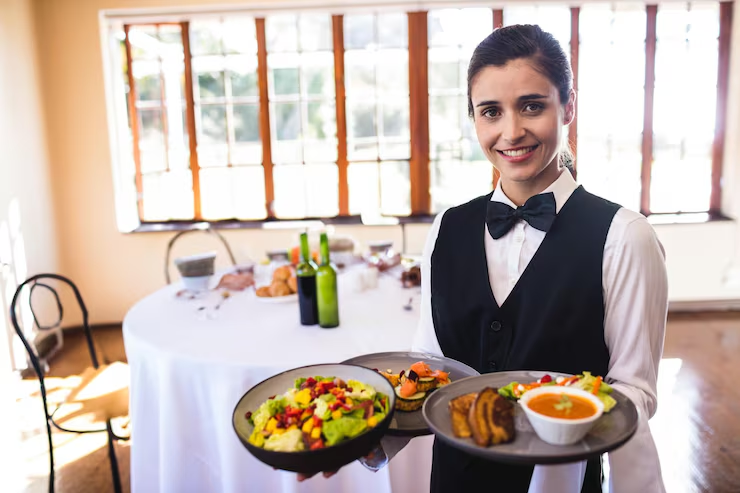
India has always been better at hospitality than the rest of the world. That's not sentiment. It's a cultural asset worth protecting.
The principle of Adithi Devo Bhava (the guest is god) is literally woven into the Upanishads. It shaped how Indian households welcomed travelers for centuries. It's the reason why a dhaaba on the highway will give a stranger a second helping without being asked, why the paan shop owner remembers your regular order after two visits, why your neighborhood biryani spot knows your kids' names.
In 2026, while the global restaurant industry is obsessing over whether AI will replace human servers, India has a very different question to answer:
How do we protect the hospitality culture we're already the best at, while we modernize the parts that are holding our staff back?
That's the right question. And the answer isn't "less technology." It's "better technology, pointed at the right problems."
The real problem isn't AI vs. humans
Walk into most independent Indian restaurants during a dinner rush and count what the servers are actually doing.
Taking orders. Reading out specials for the fiftieth time that night. Answering "is this spicy?" Answering "is this Jain?" Answering "what's the difference between the Hyderabadi and the Lucknowi biryani?" Running back to the kitchen to check if the prawns are fresh tonight. Coming back to explain they're out of mutton. Taking a modified order. Running to the counter to punch it into Petpooja. Running back with the wrong glass of water.
By the time the food arrives, that server has spent 80 percent of their time and mental bandwidth on information handling.
What they haven't been doing: reading the mood of the table. Noticing it's a date. Noticing the elderly uncle looks confused by the menu. Remembering that the family at table 4 comes every Saturday and their son loves the gulab jamun. Upselling thoughtfully. Building the relationship that turns a one-time visit into a regular.
The hospitality culture is still there. The staff know how to do it. They just don't have the time or attention because they're drowning in low-value work.
This is the actual tension in Indian restaurants in 2026. Not "technology is replacing humans." But "non-technology is preventing humans from doing the most human parts of their job."
What order-taking actually costs you
Let's make this concrete. A typical independent Indian restaurant server spends roughly:
35 to 40 percent of floor time on order-taking and menu explanations
15 to 20 percent on running between kitchen, counter, and table for updates
10 percent on billing and payment handling
10 percent on water, condiments, and basic service
Which leaves maybe 20 to 25 percent for actual hospitality
Most Indian restaurant owners would probably want that last number to be closer to 50 percent. The food is the product but the service is the memory. A server who spends more time reading the table is worth more than one who spends more time reading the menu out loud.
The question is: how do you buy your servers more time for the part of their job that actually makes customers return?
Digital menus are not about removing the human. They're about removing the repetition.
Here's the reframe most Indian restaurant owners miss.
A QR menu at the table doesn't replace your server. It removes the part of their job that was always the least hospitable anyway: reciting the menu to every new table like a script.
With a digital menu in front of the guest:
The guest can browse at their own pace, without a server hovering
They can see photos and descriptions without asking "what is this"
Dietary filters (veg, non-veg, Jain, gluten-free) handle themselves
The bill splits itself across the table without math mistakes
86'd items never show up, so no awkward "finished, sir" conversations
The server is free to walk up when the guest actually wants them there, not when they're forced to
The server's role shifts from information clerk to genuine host. They can ask "first time with us?" instead of "ready to order?" They can notice the grandparents at the table and suggest something softer. They can remember the regulars. They can do the thing Indian restaurants have always done best.
This is pro-hospitality technology, not anti-hospitality technology.
What this looks like in practice
Think about two versions of the same Saturday night at a 60-seat Bangalore restaurant.
Version 1: Traditional menu, traditional service.
Servers rush between 15 tables. Each table gets 40 seconds of menu explanation time, repeated 15 times a night. Modifications are shouted across the floor. Bills are split manually and have errors. Three 86'd items are still getting ordered and then cancelled. The anniversary couple at table 9 doesn't get noticed because the server is at the counter punching in orders from table 12.
Version 2: QR digital menu, same staff, same floor.
Guests browse on their phones. The server greets the table, asks about the occasion, notices the anniversary couple, walks the family at table 4 through their favorites (because they don't need to explain the menu, they can actually talk about the food). Orders flow directly from the guest's phone to Petpooja. No miscommunication, no lost tickets. When the server visits the table, they're there to connect, not to collect.
Same staff. Same floor. Completely different experience.
The server didn't get replaced. The server got promoted.
Why this matters more in India than anywhere else
Indian operators sometimes look at digital menus and worry the technology feels cold or impersonal, which is the opposite of the Indian dining experience they've built. The concern is valid, but the conclusion is backwards.
Indian hospitality is unique globally because of the depth of the human connection, not the absence of technology. Taj Hotels and Oberoi built international reputations by training staff to remember guest preferences, anticipate needs, and create personalized experiences. They didn't do this by refusing technology. They did it by using technology for the back of house work (inventory, reservations, billing) so their front of house could focus on people.
The independent Indian restaurant can do the same thing at a much lower investment. You don't need Oberoi's technology budget to free your servers from order-taking. A QR menu connected to your Petpooja POS does the same thing for Rs 1000 a month.
The opportunity isn't digital vs. human. It's taking the Indian hospitality advantage and multiplying it by freeing staff to actually deliver it.
What technology should do, and what it shouldn't
Here's the principle worth tattooing on every Indian restaurant operator's wall:
Technology should do the backstage work. Hospitality is the show.
Backstage (automate this):
Order taking and kitchen routing
Menu updates across POS, Swiggy, Zomato, and table menus
Bill generation and splits
GST compliance
86'd item management
Inventory sync
Onstage (never automate this):
The welcome at the door
The recommendation based on reading the table
The check-in mid-meal
The remembering of the regular
The small kindness to the elderly uncle
The handshake with the owner who came in after a long day
The restaurants that get this distinction right will dominate the next decade of Indian dining. The ones who don't will either fall behind on efficiency (losing to more modern competitors) or fall behind on hospitality (losing their cultural edge by spreading their staff too thin).
The playbook for Indian restaurant owners
If you're thinking about how to modernize without losing what makes your restaurant great:
1. Digitize order-taking. QR menus at tables, or at minimum, a shared table-side device. This is the single biggest lift you can give your servers.
2. Retrain your servers as hosts, not order-takers. Once they have time, they need to know what to do with it. Train them to read tables, remember regulars, make recommendations, handle special occasions.
3. Keep the human touches that actually matter. Greet every guest at the door. Have the owner walk the floor at peak hours. Send a complimentary gulab jamun to the anniversary table. These are the things technology can't replicate and shouldn't try to.
4. Measure hospitality, not just efficiency. Track repeat customer rates, not just ticket times. Track Google review sentiment, not just average order value. The goal is more human connection per shift, not less.
5. Connect your menu to your POS, Swiggy, Zomato, and every other surface. The coordination work that used to occupy staff becomes invisible. They get that time back for hospitality.
That last point is where Menuthere fits in. Our digital menu platform integrates with your Petpooja POS so order-taking, menu updates, and surface coordination happen automatically. Your servers get their time back. Your hospitality culture gets room to breathe.
The bottom line
India has the best hospitality culture in the world. It doesn't need protecting from technology. It needs protecting from all the non-hospitable work that's eating up your staff's time.
Adithi Devo Bhava is a 3,000 year old principle. It survived empires, partition, liberalization, and the rise of the aggregator economy. It will easily survive the adoption of a QR menu.
The only thing that can kill it is leaving your staff so buried in order-taking and running between tables that they forget how to practice it.
The restaurants that will define Indian dining in 2026 and beyond will be the ones who use technology to make their servers more human, not less. That's the real Hospitality Gap, and closing it is the single biggest competitive advantage available to Indian restaurant owners right now.
Want your staff to spend less time taking orders and more time being hosts?
Menuthere's digital menu platform, integrated with Petpooja, gives your servers back the time they need to do what Indian hospitality has always done best.
Sources: NRAI India Food Services Report 2024; Hospitality.Institute analysis of Indian service traditions; Foodism Connect "Adithi Devo Bhava in Action"; The Oberoi Group and Taj Hotels guest service case studies; Petpooja operator guides.